
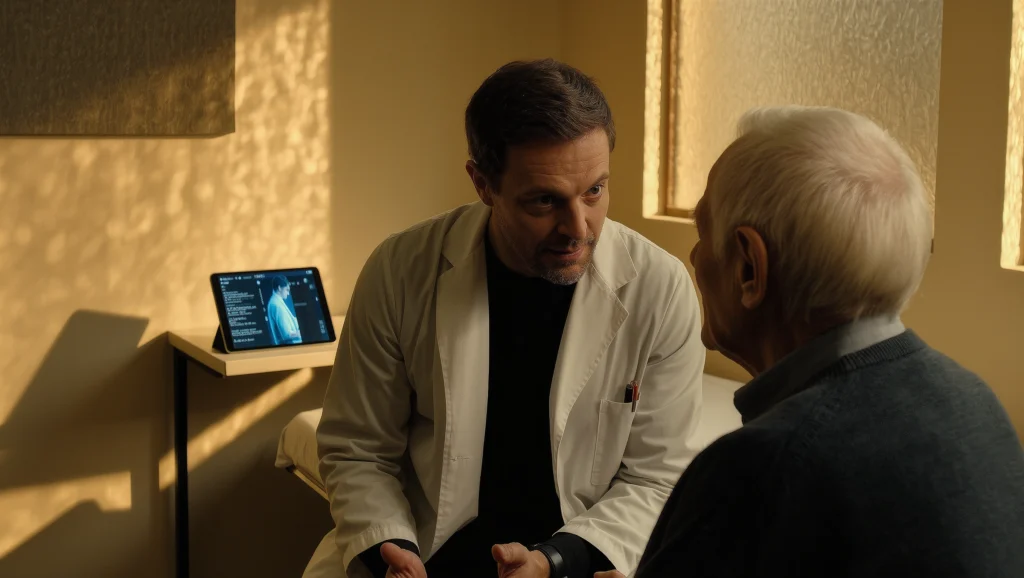
Ambient AI documentation tools are ending the era of the “pajama physician” — and restoring the human connection at the heart of medicine.
There is a quiet tragedy that has been playing out inside examination rooms for over a decade. The moment a physician opens a laptop, something changes in the room — the patient watches the back of a head instead of a face, a keyboard replaces conversation, and the ancient human ritual of one person helping another becomes mediated by a screen. For each hour of direct patient care, physicians now spend up to two hours on electronic health record tasks, according to research published in JMIR AI. The tool meant to improve care coordination had, in many ways, quietly stolen the soul of the clinical encounter. In 2026, ambient AI scribes are beginning to give it back.
✦ ✦ ✦
Ambient AI scribes work by listening — with the patient’s consent — to the natural conversation between doctor and patient during an appointment. Machine learning models convert that conversation into a structured clinical note, populated in the physician’s preferred format, ready for review the moment the visit ends. The physician becomes an editor rather than a typist, checking and approving rather than generating from scratch. The results from real-world deployments are striking. A landmark rollout by The Permanente Medical Group in late 2023 enabled the technology for 10,000 physicians across diverse specialties. Statistical analyses following implementation found the system was directly linked with reduced time spent on documentation and in the EHR, according to a study published in NEJM Catalyst. What was once called “pajama time” — the hours physicians spend catching up on notes at home after a full clinical day — is measurably shrinking.
“Experienced users achieved reduced documentation time and improved patient engagement without affecting consultation duration — the technology reallocates clinician effort toward patient interaction.”
The benefits extend well beyond the physician’s experience. A 2026 time-motion study published in JMIR Medical Informatics evaluated ambient scribe use in a real-world hospital setting and found that experienced users improved patient engagement without extending appointment times. Patients reported feeling more heard; clinicians reported feeling more present. The eye contact that defines a trusted clinical relationship — long sacrificed on the altar of documentation compliance — is returning. Research from the Gold Coast Hospital and Health Service found that ambient listening technology was associated with positive experiences for both staff and patients, with improved note quality and accuracy as an additional benefit.
Adoption is accelerating rapidly across hospital systems, though researchers are careful to note that the evidence base continues to mature. A randomized clinical trial in 2025 directly compared two leading ambient scribe platforms — DAX v2.0 and Nabla v1.5 — finding meaningful efficiency gains in documentation workflows. Payers and health system administrators are equally interested: a cohort study published in JAMA Network Open in January 2026 found that AI scribe adoption was linked with changes in physician financial productivity metrics, suggesting the technology may ultimately reshape not just how clinicians work, but how care is financed and valued. The ambient scribe is no longer a novelty — it is rapidly becoming a standard of care.
Sources & References
- PMC / JMIR AI. (2026). Real-World Evidence Synthesis of Digital Scribes Using Ambient Listening and Generative AI for Clinician Documentation Workflows. PubMed Central
- NEJM Catalyst. (2024). Ambient Artificial Intelligence Scribes to Alleviate the Burden of Clinical Documentation. catalyst.nejm.org
- JMIR Medical Informatics. (Mar 2026). Impact of an Ambient AI Scribe Among Clinicians and Patients: Real-World Prospective Observational Time-Motion Study. medinform.jmir.org
- BMC Health Services Research. (Jan 2026). Performance, Acceptability, and Impact of Ambient Listening Scribe Technology in an Outpatient Context. PubMed Central
- JAMA Network Open. (Jan 2026). Ambient Artificial Intelligence Scribes and Physician Financial Productivity. Holmgren et al. PubMed Central
- MedRxiv. (2026). Longitudinal Effects of Ambient AI Scribe Use on Documentation Burden and Financial Productivity. medrxiv.org
Article 02 of 03 · Clinical Workflow