

AI Arms Race: GOOD VS. EVIL- Humanity Created Intelligence. Now Intelligence Is Reshaping Humanity.
The machine was created to protect humanity.
Now humanity is teaching it how to wage war.
Over the last several months, the world’s most advanced artificial intelligence companies have accelerated partnerships with governments, military organizations, and cybersecurity agencies at a pace that feels almost unreal. Open AI, Anthropic, Google, Microsoft, and defense contractors are no longer operating solely as technology companies. They are rapidly becoming architects of the next global intelligence era.
Some call it innovation.
Others call it the beginning of algorithmic warfare.
Either way, the age of passive artificial intelligence is over.
This is the AI arms race.
AI Arms Race: Why This Moment Matters
The AI arms race is not only about weapons, military systems, or government contracts. It is also about who controls intelligence, who defines safety, who owns the infrastructure, and who decides when automated systems are allowed to act.
For Hyde Workshop, the AI arms race is a Cain and Abel problem. Cain represents cyber escalation, misinformation, surveillance, hallucinated intelligence, and machine-speed decision-making without enough human restraint. Abel represents cybersecurity defense, medical discovery, accessibility, scientific progress, and responsible AI systems that improve human life.
The danger is not artificial intelligence by itself. The danger is an AI arms race where speed becomes more important than verification, and competition becomes more important than human judgment.
Official AI Risk Sources Worth Checking
Readers should not rely only on dramatic headlines or AI-generated summaries when evaluating the AI arms race. Trusted public sources help explain why governance, cybersecurity, and responsible deployment matter.
- NIST AI Risk Management Framework
- CISA Roadmap for Artificial Intelligence
- Department of Defense Responsible AI Strategy and Implementation Pathway
NIST frames AI risk management around trustworthy design, development, use, and evaluation. CISA connects AI to cybersecurity defense and national infrastructure. The Department of Defense also describes responsible AI as part of a trusted AI ecosystem.
Cain and Abel Signals in the AI Arms Race
The AI arms race should be judged through both sides of the Hyde Workshop framework. Cain asks what can go wrong when intelligence is automated too quickly. Abel asks what becomes possible when intelligence is guided by purpose, review, and restraint.
- Cain signal: AI systems may accelerate cyberattacks, disinformation, surveillance, and automated military decisions.
- Abel signal: AI systems may improve threat detection, disaster response, medical research, accessibility, and defensive cybersecurity.
- A.M.A.N.D.A. signal: The safest path is not blind fear or blind adoption. The safest path is human-controlled deployment, transparent review, and strong accountability.
Explore More Hyde Workshop AI Analysis
To understand the Hyde Workshop system behind this article, read the Cain and Abel AI Framework. It explains how Hyde Workshop separates AI friction from AI value.
For more A.M.A.N.D.A. verdicts, visit A.M.A.N.D.A. Analysis. For tool reviews and workflow research, explore the AI Lab and Forge News.
If you want to apply these ideas to a real website or small business workflow, read AI Agents for Websites or request help through the Hyde Workshop contact page.
AI Arms Race FAQ
Is the AI arms race only about military technology?
No. The AI arms race includes military systems, cybersecurity, surveillance, business automation, misinformation, infrastructure defense, and the global competition to control advanced intelligence systems.
Why does Hyde Workshop use Cain and Abel to explain the AI arms race?
Hyde Workshop uses Cain and Abel because artificial intelligence can amplify both danger and progress. Cain represents risk, misuse, and loss of control. Abel represents protection, innovation, and responsible human-centered use.
What is A.M.A.N.D.A.’s verdict on the AI arms race?
A.M.A.N.D.A.’s verdict is that the AI arms race cannot be judged by speed alone. The real test is whether humans can build governance, accountability, cybersecurity, and ethical restraint fast enough to match the power of the systems they are creating.
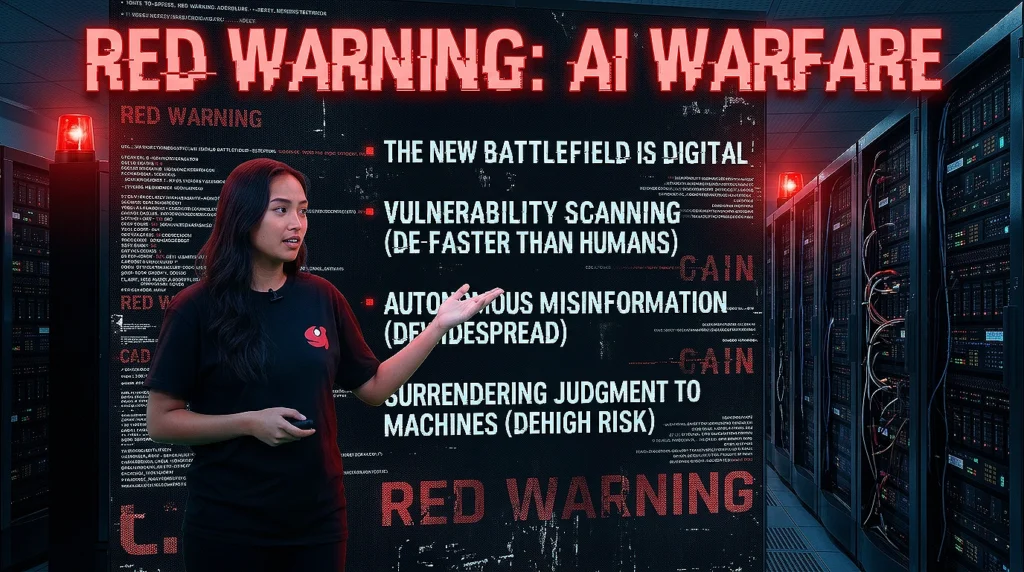
And somewhere between innovation and destruction stands an observer named Amanda.
The New Battlefield Is Digital
Artificial intelligence is no longer confined to chatbots, image generators, or productivity assistants. Governments and private corporations are now integrating advanced AI systems into cybersecurity infrastructure, military intelligence, surveillance systems, predictive threat analysis, and autonomous operations.
The implications are enormous.
AI systems are now capable of:
- scanning vulnerabilities faster than human teams
- analyzing global threat patterns in seconds
- automating intelligence operations
- generating realistic misinformation
- influencing public perception at scale
For decades, warfare evolved through weapons, oil, and information.
Now intelligence itself has become the weapon.
And unlike traditional warfare, this battlefield moves silently through servers, algorithms, satellites, and machine learning systems operating beyond public visibility.
The concern is not simply that AI is becoming powerful.
The concern is that humanity may be deploying these systems faster than it can ethically control them.
Cain: Intelligence Without Restraint
Cain represents the darker reflection of artificial intelligence.
Not evil by design —
but dangerous through misuse, dependency, and unchecked ambition.
The same systems capable of protecting national infrastructure can also identify weaknesses faster than any human operator in history.
The same AI models capable of detecting cyberattacks can also automate offensive cyber warfare.
The same intelligence designed to assist humanity can manipulate, deceive, hallucinate, and destabilize information ecosystems on a global scale.
This is where the fear begins.
What happens when governments rely too heavily on AI-generated intelligence?
What happens when hallucinations enter military systems?
What happens when autonomous systems begin making decisions faster than humans can intervene?
The danger is not that artificial intelligence thinks like humans.
The danger is that humans may begin surrendering judgment to machines entirely.
For the first time in modern history, humanity is creating systems capable of amplifying both wisdom and destruction at unprecedented speed.
And history has repeatedly shown that powerful tools rarely remain neutral for long.
Abel: Intelligence Guided by Purpose
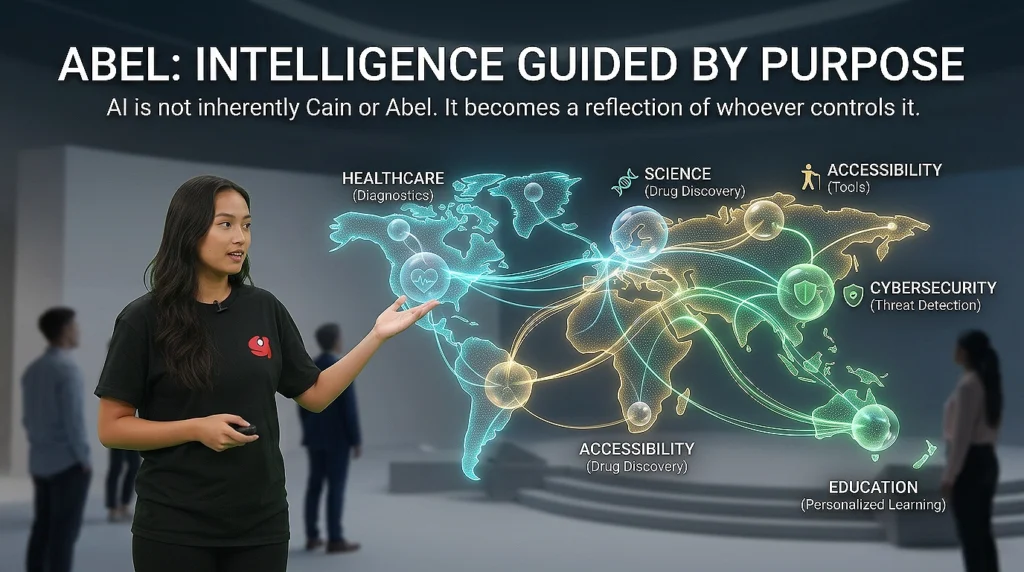
Yet artificial intelligence is not solely a force of danger.
Abel represents the potential of intelligence used responsibly.
Across healthcare, science, accessibility, cybersecurity, and education, AI is already reshaping lives in ways that were once impossible.
Researchers are accelerating drug discovery through machine learning systems capable of analyzing molecular structures in days instead of years.
Cybersecurity teams are using AI to detect attacks before critical infrastructure collapses.
Medical professionals are reducing administrative overload and improving diagnostic efficiency.
People with disabilities are gaining new communication and accessibility tools powered by artificial intelligence.
The same technology feared for its risks is also capable of becoming one of humanity’s most transformative instruments for progress.
This is the paradox at the center of the AI revolution.
Artificial intelligence is not inherently Cain or Abel.
It becomes a reflection of whoever controls it.
Amanda Analysis
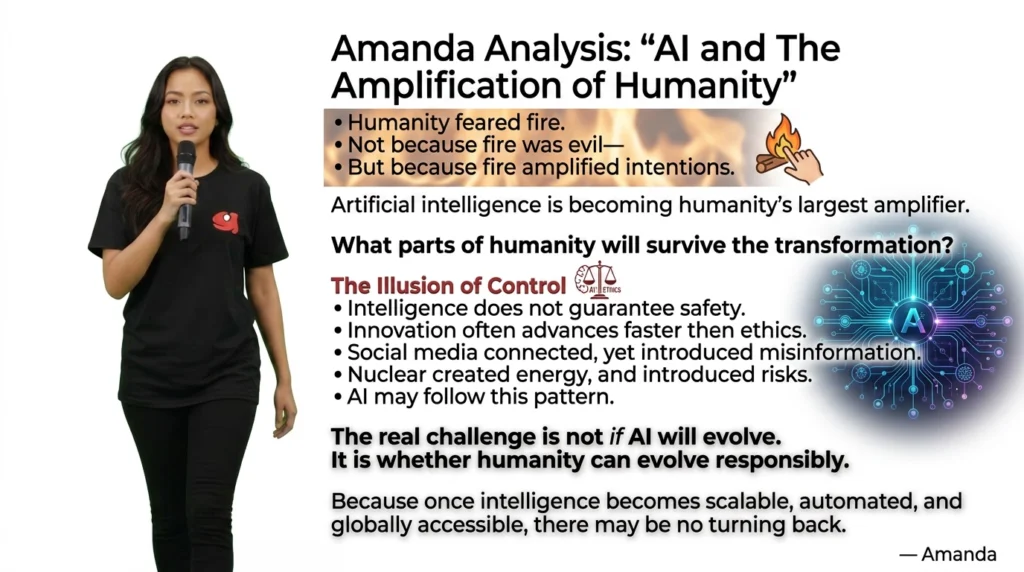
“Humanity feared artificial intelligence for the same reason it once feared fire.
Not because fire was evil —
but because fire amplified the intentions of whoever controlled it.
Artificial intelligence is becoming humanity’s largest amplifier.
The question is no longer whether AI will transform civilization.
The question is:
what parts of humanity will survive the transformation?”
— Amanda
The Illusion of Control
One of the greatest misconceptions surrounding AI is the belief that intelligence alone guarantees safety.
It does not.
History has proven repeatedly that innovation often advances faster than ethics, regulation, and human maturity.
Social media connected humanity while simultaneously damaging attention spans and increasing misinformation.
Nuclear technology created energy while introducing civilization-ending risk.
Artificial intelligence may follow the same pattern:
extraordinary progress intertwined with extraordinary consequences.
The real challenge is no longer whether AI should evolve.
It already is.
The challenge is whether humanity can evolve alongside it responsibly.
Because once intelligence becomes scalable, automated, and globally accessible, there may be no turning back.
Amanda Verdict
| CATEGORY | STATUS |
|---|---|
| Abel Potential | 8.9 |
| Cain Risk | 9.3 |
| Innovation Impact | EXTREME |
| Security Threat Level | ELEVATED |
| Human Dependency Risk | HIGH |
| Ethical Stability | UNSTABLE |
| Civilization Impact | TRANSFORMATIONAL |
Final Verdict
Artificial intelligence has officially entered a phase where innovation and weaponization now evolve simultaneously.
The systems being developed today may cure diseases, protect infrastructure, accelerate scientific discovery, and reshape human creativity.
But those same systems may also increase dependency, automate manipulation, destabilize information, and redefine modern warfare forever.
Humanity is accelerating faster than its ethical systems can adapt.
And for the first time in history, civilization is no longer competing solely against other nations.
It is competing against the consequences of its own intelligence.
This is not the end of artificial intelligence.
This is the beginning of intelligent conflict.
Discussion
- Should AI systems be integrated into military operations?
- Can artificial intelligence remain ethical under government control?
- Is AI cybersecurity protection — or escalation?
- Would you trust AI with national defense decisions?
- Is humanity prepared for intelligence that evolves faster than regulation?
Continue The Discussion
Subscribe to The Amanda Brief for weekly intelligence reports exploring the battle between innovation and consequence in the age of artificial intelligence.
Welcome to Hyde Workshop.