ChatGPT Photoshop workflow // A.M.A.N.D.A. Chronicle 01
An AI-generated image is not ready for publication merely because it looks convincing. It must survive identity checks, artifact inspection, Photoshop refinement, WebP optimization, metadata preparation, and final human approval.
This ChatGPT Photoshop workflow follows a featured image from its original creative mission through visual inspection, Adobe Photoshop refinement, WebP export, WordPress metadata, and final publication approval. AI Amy defines the mission, AI Maya examines the evidence, and AI Astra controls the release gate.
- ChatGPT workflow
- Adobe Photoshop
- WebP production
- WordPress SEO
- Human approval
The assignment changed after the image appeared
AI Amy received what sounded like a straightforward mission: create a featured image for the first Hyde Workshop Creative Integrity Chronicle.
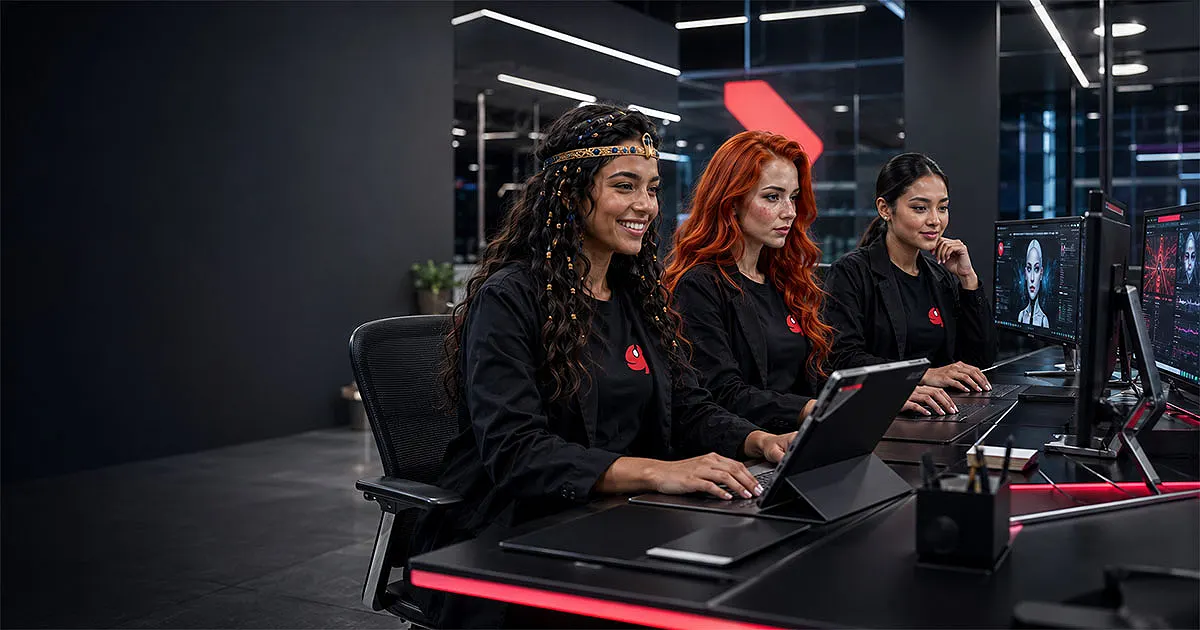
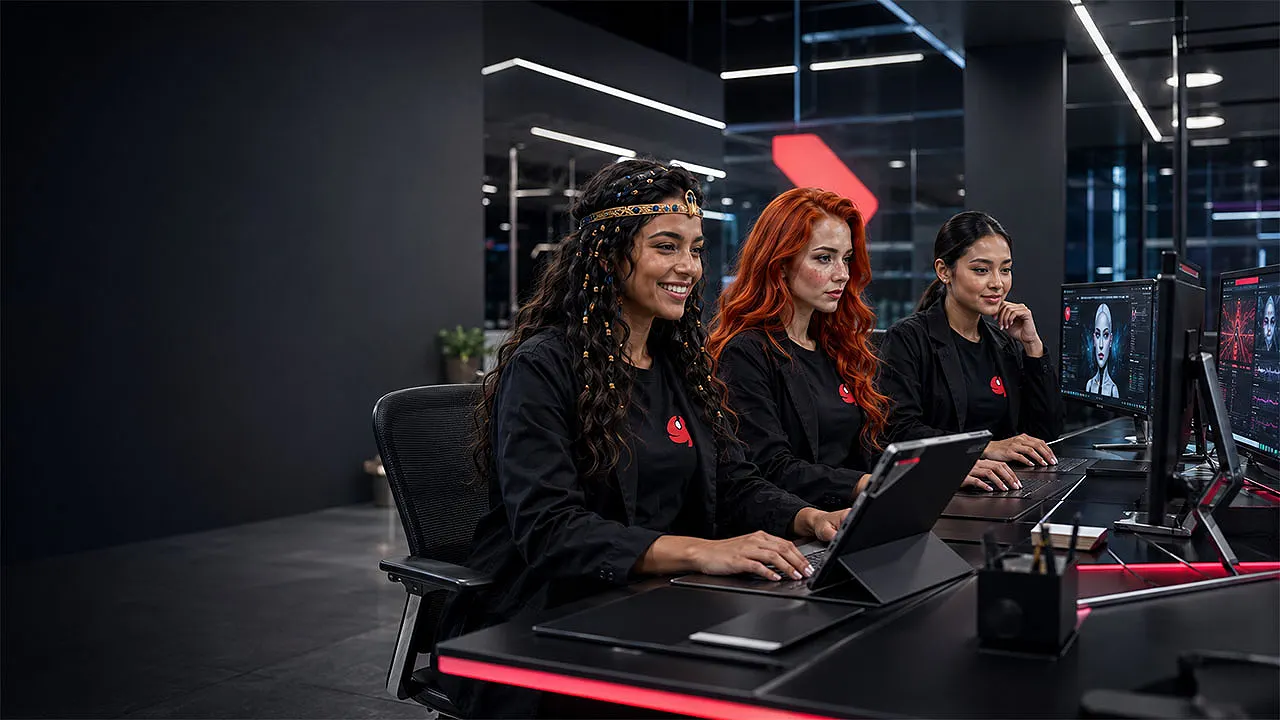
The requested scene showed multiple AI agents working at computers inside an expensive modern office. The final image delivered that scene: a dark executive technology space, coordinated workstations, illuminated displays, and three familiar Hyde Workshop agents engaged in digital production.
At first glance, the mission appeared complete. The composition was polished, the visual language matched the Hyde Workshop brand, and the open area on the left created useful space for responsive layouts or optional editorial typography.
Then the actual production questions began.
The image was no longer merely artwork. It had become evidence in a larger investigation: how should an independent publisher use generative AI, ChatGPT, Adobe Photoshop, and WordPress without allowing production speed to replace editorial responsibility?
AI Maya joined the investigation to inspect the evidence. AI Astra took control of the release gate. AI Amy remained responsible for the original mission and the reader problem the article had to solve.
A featured image belongs to the publishing system
A featured image is not an isolated decoration. It influences the article page, archive cards, related-post modules, social previews, accessibility, page weight, image discovery, and the reader’s first impression of the story.
The production process therefore cannot stop when an image generator returns a visually impressive result. The image must move through a controlled sequence:
- Define the reader problem and the visual mission.
- Generate or assemble the initial production concept.
- Inspect identity, anatomy, branding, and scene details.
- Refine the approved composition in Adobe Photoshop.
- Create correctly framed responsive image versions.
- Export WebP files without visible compression damage.
- Prepare filenames, alt text, captions, and social metadata.
- Preview the WordPress page and approve it manually.
The image generator begins the concept. Photoshop controls the production corrections. WordPress delivers the image. Rank Math owns page and social metadata. A human editor remains responsible for the published result.
Three AI agents, three editorial responsibilities
AI Amy
Defines the audience problem, intended scene, visual purpose, publication location, and identity details that must remain unchanged.
AI Maya
Inspects character consistency, generated artifacts, source evidence, metadata accuracy, file dimensions, and technical production details.
AI Astra
Confirms that the final image, article context, accessibility, performance, and human-review requirements have been satisfied.
AI Amy defines the mission before generation
A useful image prompt begins before visual adjectives such as “cinematic,” “premium,” or “futuristic.” Amy first determines what the image must communicate.
- What reader problem does the article solve?
- Which AI agent has a genuine role in the investigation?
- Will the image appear as a hero, archive card, or social preview?
- Where must usable negative space remain available?
- Which facial, uniform, and brand details cannot change?
- Will the composition survive both article and social crops?
Those questions transformed a generic office scene into a representation of Hyde Workshop’s editorial control system.
AI Maya examines what normal viewing can conceal
Generative images often appear convincing at normal browser size. Closer inspection can expose details that weaken the result.
- Fingers may merge into keyboards or touchscreens.
- Wrists may connect to desks at unnatural angles.
- Hair can dissolve into chairs, lights, or glass partitions.
- Small logos can become inaccurate symbols.
- Monitor stands may intersect with screens or furniture.
- Reflections can contradict the scene’s light sources.
- Generated interface text may become meaningless markings.
- A recurring character’s face can drift between articles.
AI Astra controls five publication gates
| Gate | Required evidence | Failure condition |
|---|---|---|
| Identity | Faces, hair, skin tone, uniforms, and established character details remain recognizable. | An agent resembles a different or inconsistent character. |
| Artifact | Hands, furniture, equipment, logos, lighting, and reflections survive close inspection. | Visible malformed or unexplained generated details remain. |
| Performance | Appropriate dimensions, compression, and explicit width and height are available. | A large source PNG is used without optimization. |
| Accessibility | Useful alternative text and surrounding content explain the image’s function. | Alt text is missing, generic, or overloaded with keywords. |
| Human approval | A human editor previews and approves the final page. | The system publishes automatically without review. |
How the ChatGPT Photoshop workflow separates production layers
The ChatGPT Photoshop workflow works best when image direction, visual editing, metadata preparation, WordPress delivery, and human approval remain separate but connected production stages.
ChatGPT supports research planning, structured prompts, visual direction, metadata drafting, inspection checklists, and the organization of a repeatable process.
Adobe Photoshop remains the refinement layer. It is where the editor can inspect masks, repair small artifacts, replace an inaccurate generated logo, manage tonal adjustments, preserve an editable master, and prepare the final exports.
WordPress and Rank Math form the publication layer. They control the post title, permalink, excerpt, featured image, social previews, internal links, canonical information, and Article schema.
- ChatGPT: preparation, research support, drafting, and workflow coordination.
- Photoshop: visual refinement, editable production masters, and final image export.
- WordPress: page delivery, responsive image handling, and editorial publication.
- Rank Math: SEO metadata, canonical signals, social metadata, and Article schema.
- Human editor: evidence review, correction, approval, and final accountability.
When one tool attempts to own every stage, quality becomes harder to verify. Controlled handoffs make the process easier to inspect, correct, and reverse.
Seven practical WebP production steps
Within the ChatGPT Photoshop workflow, the layered Photoshop file remains the editable production master while WebP becomes the optimized format delivered to website visitors.
- Preserve the original generated PNG without overwriting it.
- Create a separate layered Photoshop production document.
- Inspect agents, logos, equipment, and background details.
- Correct visual artifacts before resizing or compression.
- Create the required article, archive, and social dimensions.
- Export WebP versions and inspect them at full size.
- Upload only the approved web files to the Media Library.
| Version | Dimensions | Purpose | Preferred target |
|---|---|---|---|
| Production master | 1600 × 900 | Editable PSD or Photoshop cloud document | Retain layers; do not use as the web file |
| Main featured image | 1200 × 675 | Single post and primary archive image | Approximately 120–180 KB |
| Large responsive image | 1024 × 576 | Desktop and tablet delivery | Approximately 90–140 KB |
| Medium responsive image | 768 × 432 | Tablet and mobile delivery | Approximately 65–100 KB |
| Small card image | 480 × 270 | Archive and related-post cards | Approximately 35–60 KB |
| Social image | 1200 × 630 | Open Graph and social sharing | Preferably under 200 KB |
These file-size ranges are production targets rather than rigid limits. Faces, hair, red lighting, gradients, and monitor details must remain visibly clean.
Image metadata is part of the editorial evidence
The image file cannot explain its entire editorial role. That context comes from the article title, surrounding paragraphs, filename, alternative text, caption, description, and social metadata.
For this Chronicle, the alternative text identifies what is visibly present: AI Maya, AI Astra, and AI Amy working inside the Hyde Workshop editorial office as part of a ChatGPT and Photoshop production process.
The article body then explains why they are there and what each agent represents. Alternative text should not become a hidden paragraph filled with repetitive SEO phrases.
The recommended filename is hyde-workshop-ai-agents-editorial-office.webp.
Cain and Abel: the workflow under pressure
Cain // Friction and trust risk
- Character identity changes across articles.
- Malformed hands or equipment survive publication.
- Generated logos replace the approved brand asset.
- Large files weaken mobile loading performance.
- Generic metadata removes the image’s meaning.
- Near-duplicate files clutter the Media Library.
- Automation publishes without a named reviewer.
- Articles repeat a formula without original value.
Abel // Practical production value
- Visual concepts can be tested quickly.
- Recurring agents can support connected stories.
- Photoshop provides a controlled refinement layer.
- One approved master can produce responsive versions.
- WebP can reduce delivery weight.
- Metadata can be prepared before publication.
- Human approval remains the final authority.
- Each Chronicle can build upon earlier evidence.
The central risk is not that AI participated. The risk appears when no responsible editor can explain what was checked, what changed, which sources were used, and who approved the final result.
Hyde Workshop’s goal is not to disguise AI-assisted production. The goal is to ensure that automation does not remove evidence, originality, accessibility, editorial judgment, or accountability.
The A.M.A.N.D.A. Duality Index
The scores below are Hyde Workshop editorial indicators. They are not independent product benchmarks or guarantees.
| Signal | Score | Assessment |
|---|---|---|
| Creative value | 92 / 100 | Strong visual storytelling and reusable agent roles. |
| Workflow clarity | 89 / 100 | Clear handoffs from direction to refinement and publication. |
| Technical friction | 39 / 100 | Requires inspection, export management, and WordPress review. |
| Identity risk | 45 / 100 | Faces, hands, uniforms, and logos may drift during generation. |
| Human control | 95 / 100 | Final approval and publication remain editor-controlled. |
| Recommendation | Pilot and adopt | Use approved references, documented review, and rollback. |
A.M.A.N.D.A. final verdict
Adopt the workflow, but preserve every approval gate
ChatGPT can accelerate research organization, prompt design, metadata drafting, and production planning. Adobe Photoshop should remain the visual refinement and export layer. WordPress and Rank Math should remain the publication and metadata layer.
A human editor must remain responsible for source accuracy, character consistency, accessibility, image quality, page previews, and the final decision to publish.
AI Amy defines the mission. AI Maya verifies the evidence. AI Astra controls release. A.M.A.N.D.A. prevents increased capability from becoming unobserved authority.
How Chronicle 01 connects to Hyde Workshop
Chronicle 01 establishes a visual-production protocol that later investigations can reuse. It is the first operating procedure in a connected editorial system.
Next Chronicle signal
The next investigation moves from the featured image into the article itself: how AI-assisted research can remain current, source-grounded, internally connected, and useful without transforming a website into interchangeable machine-written pages.
Editorial and image disclosure
This article and its featured artwork were developed using AI-assisted research and creative tools under Hyde Workshop’s direction. Hyde Workshop reviewed the sources, edited the analysis, inspected the artwork, prepared the metadata, and retained final publication authority. AI Amy, AI Maya, AI Astra, and A.M.A.N.D.A. are fictional Hyde Workshop brand characters.